
Many traders assume that logging into an exchange is a purely technical step — you enter credentials, click a button, and the market appears. That assumption hides crucial trade-offs: custody vs. control, spot simplicity vs. derivatives complexity, and convenience vs. security. This article explains how OKX structures those trade-offs for U.S.-based traders, how spot and futures differ mechanistically, what the platform’s key safeguards actually accomplish, and where users should be especially careful when they go from “okx sign in” to placing a real trade.
I’ll start by correcting one persistent misconception: an exchange’s breadth — the number of tokens and blockchains it supports — is not the same as liquidity or execution quality for every asset. OKX lists 300+ cryptocurrencies across 130+ blockchains, but that variety is not a substitute for understanding order books, slippage, and the unique risks of margin or perpetuals. Read on for a mental model you can reuse every time you plan a trade, plus a practical checklist to reduce surprise losses.
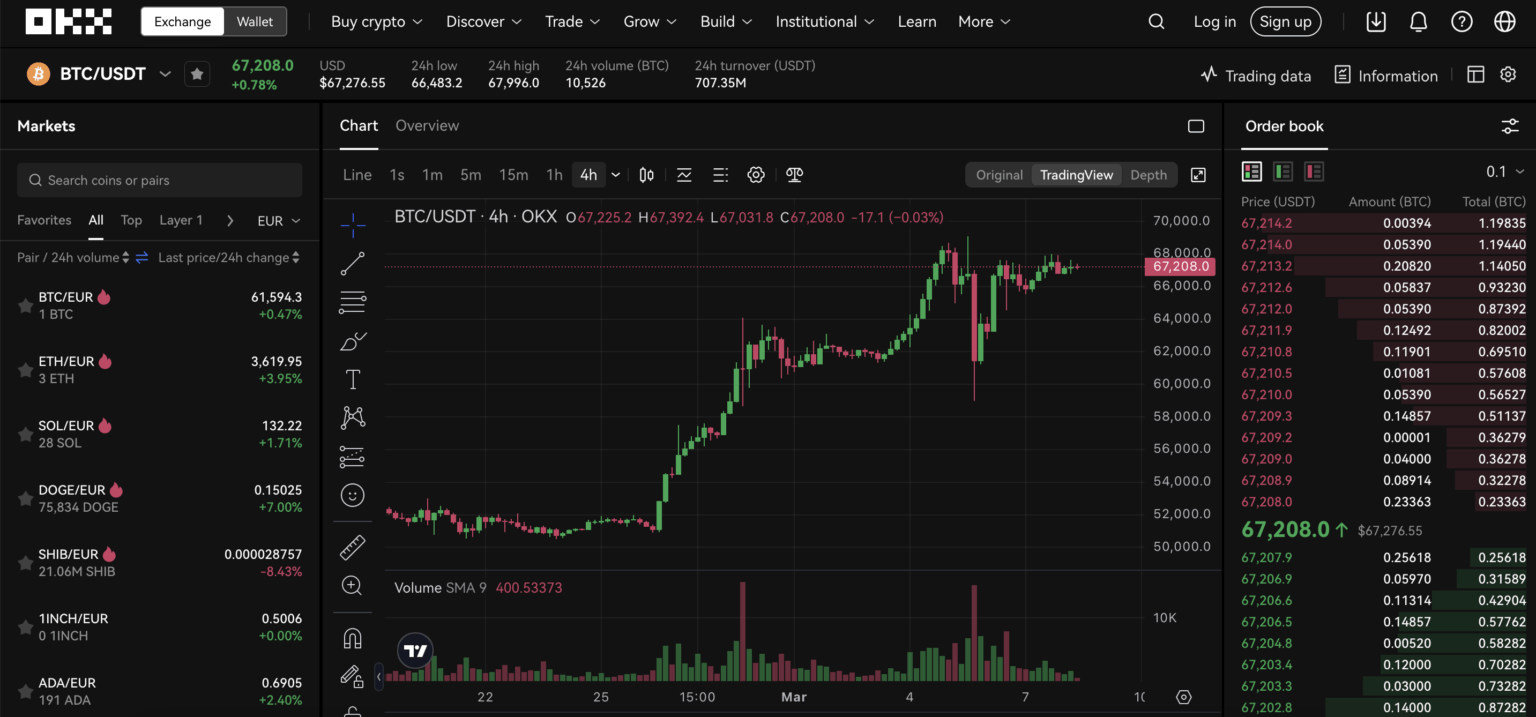
How OKX’s spot market works (mechanism, not hype)
Spot trading is the simplest counterparty model: you buy an asset at the market price and receive custody of that token (on the exchange or to your wallet). Mechanically, an OKX spot order interacts with a central limit order book (CLOB). Limit orders sit in the book; market orders remove liquidity and incur the immediate bid-ask spread. Understanding this book-level mechanism matters because slippage and price impact are not random — they scale with order size relative to available liquidity.
OKX supports over 300 assets, which sounds like choice, but liquidity distribution is uneven. For major pairs (BTC, ETH, top stablecoin pairs) spreads are narrow and depth is high; for recently delisted or low-volume tokens, spreads can widen quickly. Case in point: the exchange recently delisted several minor pairs (a routine measure exchanges take to manage market quality). That delisting reminder matters: listing count is not the same as tradability.
Practical takeaway: always check order book depth and recent trade size distribution before sizing a market order. If you see depth thin out beyond a small percentage of your intended trade, split the order or use limit orders to avoid adverse price execution.
Futures and derivatives: leverage, funding, and the liquidation mechanism
Futures and perpetual swaps on OKX are engineered to give directional exposure without owning the underlying token, using leverage and margin frameworks. The platform offers up to 125x leverage on select products; margin modes include isolated and cross. Mechanically, leverage amplifies both gains and losses because your margin functions as collateral for a larger notional position, and maintenance margin thresholds determine when the system forcibly closes positions (liquidation).
This is where a common misconception becomes dangerous: leverage does not change the expected direction of market movement; it changes risk sensitivity. With 10x leverage, a 10% adverse move can wipe out posted margin. OKX’s liquidation engine reduces systemic risk for the platform but transfers realized loss to the trader — often faster than manual intervention is possible. For U.S.-based traders, regulatory constraints and product availability may further shape which derivatives are offered, so confirm permitted instruments after you okx sign in.
Decision heuristic: if you cannot tolerate a full loss of the margin you post in an intraday swing, do not use high leverage. Prefer isolated margin for discrete bets and cross margin cautiously when you want portfolio-level collateralization, recognizing cross margin also spreads risk across positions.
Security architecture and where it stops protecting you
OKX states that over 95% of user assets are stored offline in air-gapped, multi-signature cold wallets — this is reliable for defending against many centralized exchange hacks. Complementing cold storage, the platform implements Proof of Reserves to allow public verification that the exchange holds assets backing user deposits. These are meaningful controls that elevate platform trust relative to smaller venues without such measures.
But security stops at the interface where human attackers work. Account protection includes military-grade encryption, AI-driven threat detection, and mandatory two-factor authentication (2FA). Those are powerful mitigations against credential compromise, yet phishing, social-engineering, and device-level compromises remain active threats. Separately, OKX’s self-custodial Web3 wallet gives users full private-key control — that eliminates exchange counterparty risk but introduces single-point failure risk (lose the seed phrase, and recovery is typically impossible).
So: custody is a trade-off. Keeping assets on the exchange leverages institutional security and cold storage benefits but exposes you to counterparty custody risk (albeit mitigated by PoR). Self-custody removes counterparty risk but places operational security on you. A hybrid approach — leaving only active trading funds on-exchange while moving longer-term holdings to a hardware-backed self-custodial wallet — is a practical compromise many seasoned traders use.
Practical workflows: logging in, account setup, and what to confirm before trading
When you first access OKX as a U.S. trader, KYC is mandatory: expect to upload government ID and complete a facial liveness check. That increases friction but is a compliance reality. After verification, configure strong 2FA (authenticator app preferred over SMS where possible), enable withdrawal whitelist features if available, and connect a hardware wallet for your non-exchange holdings.
Before you place a spot or futures trade, run this quick checklist: 1) Verify the order book depth for your pair; 2) Confirm margin settings (isolated vs. cross); 3) Know the funding rate and settlement cadence for perpetuals; 4) Ensure your withdrawal whitelist is up to date; 5) Keep an eye on recently delisted tokens or pairs that might affect liquidity. These small checks reduce the chance of execution surprises or unexpected loss.
Where OKX’s product mix fits — and where other platforms win
Compare three archetypes: a broad CEX like OKX, a lean high-liquidity spot exchange, and a decentralized exchange (DEX) aggregator. OKX’s strengths are product breadth (spot, margin, futures, options, staking, PoR, NFT marketplace, and Web3 wallet integration) and cross-chain connectivity. A lean spot exchange may offer marginally better spreads on a narrow set of pairs due to focused liquidity. A DEX aggregator excels at noncustodial swaps across chains without KYC, but introduces smart-contract risk and typically worse price execution for large trades.
Trade-off summary: choose OKX if you value a unified interface, multiple product types, and institutional-grade custody; choose a specialized spot venue if you need the tightest spreads on a handful of pairs; choose a trusted DEX aggregator for noncustodial, cross-chain swaps when you accept smart-contract risk. None of these is strictly superior — they serve different tactical goals.
Limitations, uncertainties, and what to watch next
Two limitations deserve emphasis. First, listings and supported blockchains do not guarantee execution quality across all assets — delistings (such as the recent removal of several low-volume pairs) are reminders that markets evolve. Second, Proof of Reserves provides snapshot transparency but is not a panacea for systemic settlement risk or regulatory actions that could affect user access. Both mechanisms help but do not eliminate all forms of counterparty or market risk.
Signals to monitor in the near term: funding-rate divergence between major perpetual contracts and spot prices (which can indicate stress), recurring delistings or relistings (which signal quality control), and regulatory guidance affecting derivatives availability to U.S. retail traders. These are concrete, observable indicators that change the trade-off calculus between custody, leverage, and product choice.
FAQ
Do I need to complete KYC to trade on OKX in the U.S.?
Yes. For U.S.-based users, KYC verification is required: expect to submit a government-issued ID and pass a liveness check. This is a compliance-driven step that enables access to deposit, withdrawal, and derivative products on the platform.
What’s the safer way to hold coins: leave them on OKX or use the Web3 wallet?
“Safer” depends on the threat you worry about. Leaving assets on OKX benefits from institutional cold storage and PoR transparency, protecting against some third-party risks. Self-custody (the Web3 wallet) protects against exchange counterparty failure but makes you solely responsible for seed phrase security. A mixed strategy — only keep active trading funds on the exchange and store long-term holdings in a hardware-protected wallet — balances these risks for many traders.
How should I size orders to avoid slippage on spot trades?
Check the order book and recent trade sizes. If your intended market order is a meaningful fraction of displayed depth, split the trade into smaller limit orders or use time-weighted execution. For large notional trades, consider OTC desks or algorithmic execution to reduce market impact.
Is using leverage on OKX risky for retail traders?
Yes, leverage amplifies both gains and losses and introduces liquidation risk. For retail traders, conservative leverage levels (2x–3x) and isolated margin modes are generally safer. Always compute the liquidation price for your position size before opening a leveraged trade.
What does Proof of Reserves on OKX actually show?
Proof of Reserves is an on-chain snapshot that aims to demonstrate the exchange holds assets corresponding to user deposits. It increases transparency but is not a substitute for continuous, audited insolvency protections or regulatory safeguards. Treat PoR as one useful data point, not definitive proof of long-term solvency under every scenario.
